Twenty-Five Epigrams To Touch Grass
On Dürer's Great Piece of Turf, artifice, nature, and the dialectics of writing the internet as new Republic of Letters

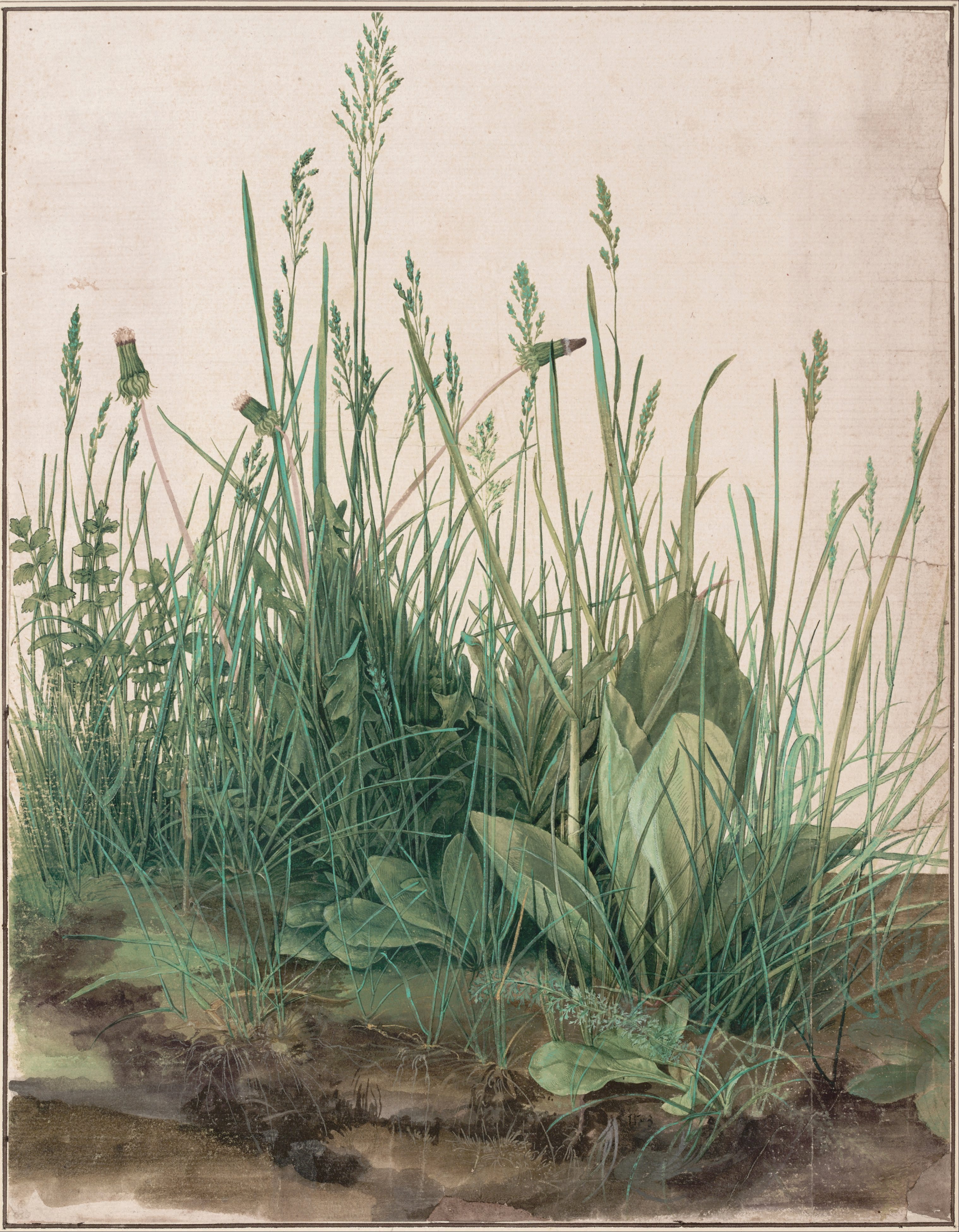
1. It is often said with a lingering sense of superiority, as if the speaker themselves has touched grass recently—pampas, crab, tall fescues, fine fescues, riveroats, cool-season turfgrasses on the expanses of the Prospect Park lawns in Brooklyn, some of which you do not want to touch for specifically New York sanitary reasons.
2. The speaker has usually not actually touched grass of any sort. Has not stood in some knee-high prarie, or prone on the side of the hill, or zoomed in, like Dürer’s Great Piece of Turf, which contains dandelion and yarrow. I would like to ask every confident toucher-of-grass-enthusiast to point me to the dandelion and yarrow in the 1502 watercolor. If they can’t they get kicked out of the Albertina and don’t get to tell anyone to touch grass again.
3. Nach Dem Natur, roughly “after nature”, is the Early Modern principle of copying which ends up being a transitive chain of telephone of images supposedly straight from nature. It ends up in Dürer’s Rhinoceros which certainly was not directly observed in the way Great Piece of Turf was. This is a classic case study of the relationship of artifice to the practice of the construction of the idea of nature in the history of western thought. Nature is more artifice than you’d think.
4. “Touch grass” is when the speaker implies that the object of their speech is “too online” as opposed to themselves, the speaker as self-appointed King of the Pansies and Mints and Hound’s Tongue that licks your kid-soft leather sixteenth-century boots with a handsome fold at the top.
5. The internet is also an artifice formed after nature by degrees of remove, mediated by human folly, error, good intentions, description, transcription, and speech acts. It’s always the sixteenth century again somewhere. Someone’s always printing up their bitchy broadsheet or Erasmian one liner that that doesn’t quite hit with the force of Erasmus, especially if it contains a hashtag. Anyway, the Early Modern Republic of Letters, the fast packet-boats that could go from Amsterdam to London in three days flat, would certainly recognize Twitter and Substack for what they are. The Early Modern Republic of Letters was often trivial, mean, and back-biting, every bit as it was revelatory and important.
6. What happens online is as real as turf, but also as real as letters and broadsheets, which is to say it’s ephemera, but ephemera still have very definite human consequences.
7. The Great Piece of Turf comes from a long tradition of exacting detail in German printmaking and in the details of Annunciations and Nativities in the period from about 1400-1600. You learn to name the plants in the corner behind Mary, the various species of lilies in the vase that become the hortus conclusus even when the vase is so precisely one imported to the Low Countries from Ming Dynasty China that you must remember global trade networks were also always already modern.
8. I touched grass. I touched the yarrow through the screen on the Great Piece of Turf. I rinsed and rinsed its brown dye on my fingers until it become the golden yellow of the haloes of saints, gessoed up like dinner-plates, stamped into real leaf on the canvas.
9. Generosity still counts on the internet. Cruelty still counts on the internet. Yarrow is named Achillea millefolium, because it was supposedly carried by Achilles to treat wounds in battle. It does, in fact help with clotting.
10. I will remember this the next time someone on the internet makes me bleed, claims it doesn’t matter because it’s not grass. I’ll pluck a yarrow-leaf and press it to the cut and the scar will remind me that words are words are words, and Odysseus is Odysseus, even long after Achilles is dead, and even disguised as a beggar.
11. Which is to say, you can say “touch grass”, but that grants no one absolution.
12. We think we don’t need absolution for things we do on the internet because the are somehow artificial but grass is natural. Congratulations, we have recapitulated the false ars-natura dichotomy of several centuries. You would love the automata of birds that sung behind the throne of particular Byzantine emperor.
13. Then again, the people who mostly or only write on the internet sometimes seem to have difficulty with the weight of print. They hype books they often struggle to finish, are better at short-form, that the internet rewards innately by mechanism of general inattention. Maybe instead of touching grass people should touch vellum, learn how it it is pricked and ruled, scraped from the dead cow into the page. Maybe we should all know how good the rag content of Early Modern paper smells, perfectly anti-acidic, no crumbling paperback this, this thing in a foam cradle in a library that you can run your fingers over.
14. I can tell the flesh side from the hair side of vellum or parchment with my fingers. I can tell you which side was inside the sheep. I can tell you that “germander speedwell” is named ironically because it wilts so quickly, and men are unfaithful. It is on the left of the Great Piece of Turf; you can see the small pointed, serrated leaves on opposite sides of the stems, which have not yet bloomed here. To make good artifice, attention to nature is fundamentally necessary as a practice. This is what we take from Dürer, among many other things.
15. Great Piece of Turf is a constructed image, it is not a piece of turf. It is artifice performing nature. If you touch it, it doesn’t count as touching grass, and you will absolutely get kicked out of the Albertina, even if you cite, pleadingly, Benjaminian reasons.
16. We live here now, the hyper-real, the representational as primary field of encounter. There is no “real life” otherwise; there is life off the internet but it still isn’t unmediated by the internet, which pervades the character of our society. The distinction is fuzzy at best and philosophically sloppy at worst. No one can sever themselves entirely; no one can claim to be more or less “real” or “natural” on these grounds, which are mostly grassless anyway.
17. The Great Piece of Turf is not haphazard. Rather it gives the appearance of being haphazard while, in fact, being so carefully constructed you can see every root bed, every leaf’s midrib, the skyward planes of each layered blade, faceted.
18. If you tell someone to touch grass the new rule is this; you must consider the nature of grass like Dürer considers the nature of grass, which is to say simultaneously as a proxy fight for what nature, images, and constructing them does in the first place.
19. Don’t touch grass, touch the construct of grass-ness, which you got from a picture, which is a high quality JPEG of a watercolor that is behind glass at the Albertina, such that when you see it in person you also see the reflection of diffused sunlight in the gallery anyway.
20. I have painted you nach dem natur, which is to say after your nature, a nature that assumes it is in the position to say something about artifice from a epistemological-moral high ground that does not exist.
21. We get the Republic of Letters we make and which the media of our time permit. We position ourselves as if we are outside it at our peril.
22. No one is superior. We are all natural to the extent that words in any medium are by nature, a human endeavor.
23. No one is superior. We are all creatures of artifice here. This is written, initially, as an internet post, the burin or brush is only a blinking cursor.
24. All of the plants in Great Piece of Turf are common weeds and wildflowers. They are not hothouse exotica, neither rare nor exalted, except in the exaltation of their exactitude in paint.
25. I touch the grass in the Great Piece of Turf by smearing my finger across my dirty laptop screen, backlit. Am I natural enough to write about the internet as medium without derision? Am I artificial enough to render it precisely? Smooth meadow-grass (Poa pratensis); it thrives in damp soil, in side places, along roads, in ditches and mud. It is a weed amongst weeds, which has become, via Dürer, an exquisitely mediated devotion, a definitional contradiction as fundamental condition for art.
Yesterday I planted four clumps of Big Bluestem grass in my yard. They may grow as much as nine feet high, with roots that go just as deep underground.
This is was such a treat to stumble upon.