Rose Period
in early summer, New York, Knicks, Saltimbanques, and strange happiness-- plus a new translation of an Apollinaire poem

This piece is a sequel of sorts to the events of Blue Period, which happened about a month before, but can be read entirely on its own if you so choose.
It’s a strange, electric municipal happiness, New York in a long-deferred early summer, with the Knicks poised to sweep the championships. Strangers in jerseys fist bump in Prospect Park while the indifferent swans, also municipal, also now lacking in deficit and rich in promises of buses and grocery stores, waddle as if hundreds of people aren’t sitting on their lawn. There are dolphins sighted under the Verrazano Narrows Bride, dolphins, as if the guy on TikTok who coined “My Mayor Muslim/My bagel Jewish/My Christian Dior/Knicks in Four” will be rescued from the swirling crowd by a pod of them and delivered to the shore of 34th street, like Arion in Ovid’s Fasti.
There is Ovid under Bryant Park, in the mosaic of the walls subway tunnel to the 7, but that’s from the Epistulae Ex Ponto, which is by nature, sadder. I’m usually an Ex Ponto person more, a later Donne in the Holy Sonnets sonnets with concerns both mundane, constant, and salvational. “My Mayor Muslim/My bagel Jewish/My Christian Dior/Knicks in Four” actually uses some of Donne’s typical structural devices if you count the syllables, not blank verse or iambic pentameter, but tercets, tetrameter, and in the final line a total prosodic departure that slams it home, last shot as it runs the clock. I buy a pair of blue Knicks basketball shorts to wear to our pointe class at the studio, the night of the third game, fair-weather fandom over my fading pink tights, but what I’m really a fan of I think, is the sudden and strange emotion of being content.
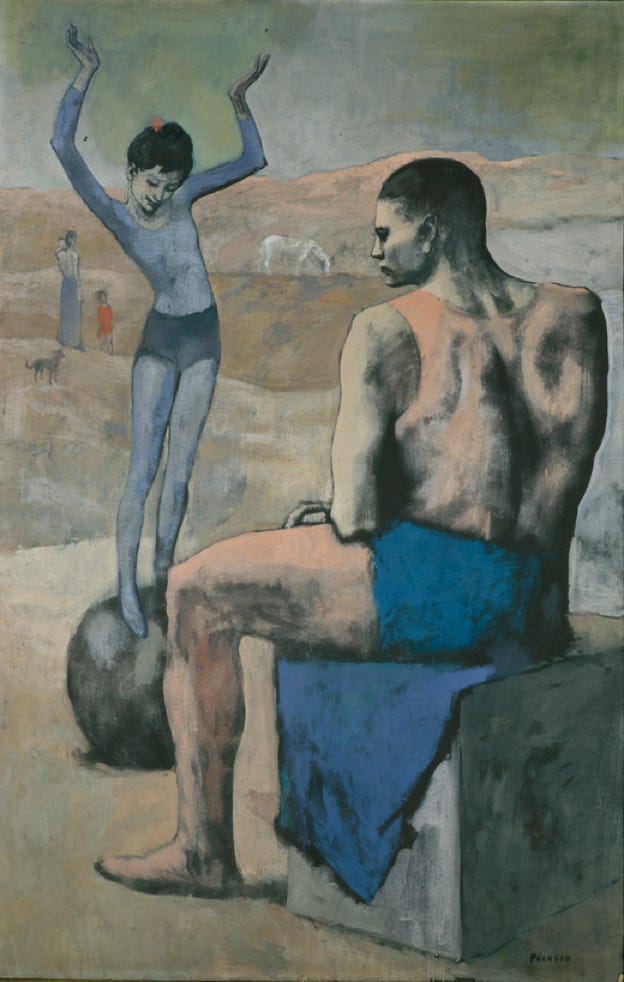
I was born under the sign of Saturn, all Sontag-Wittkower-Burton melancholic, and this is all still fairly alien to me, a compatible happiness that meshes with the world instead of going crossgrain to it. About a month ago I was Blue Period, but I’m Rose Period now, I’ve come fully into my own again in time for summer. I finished the manuscript of my second book, tied it in a spent ballet shoe ribbon, and delivered it to my publisher on the first hot day in bleached denim short-shorts. I stopped in Chinatown and bought a gaudy necklace, a round cubic zirconia solitaire, to dazzle above my leotards and warm weather tank tops, and to flash when I turned. I am obsessed with pinning my growing hair up now, in claw clips that hold it like interlocking enjambments. In the Rose Period, Picasso often painted himself as Harlequin, a clown, or an acrobat. I twist my hair up like Acrobat On A Ball, in acetate patterned like a tortoise shell, or clasped in matte silicone lilac. The clips pile up on my desk. When I look down like she looks down on the canvas, I smile because I am square over my pointe shoe boxes, those centimeters of papier-mâché paste that put you in the air in pink satin. A month ago, I was miserable; now look at me! I am a contortionist, an acrobat of happiness.
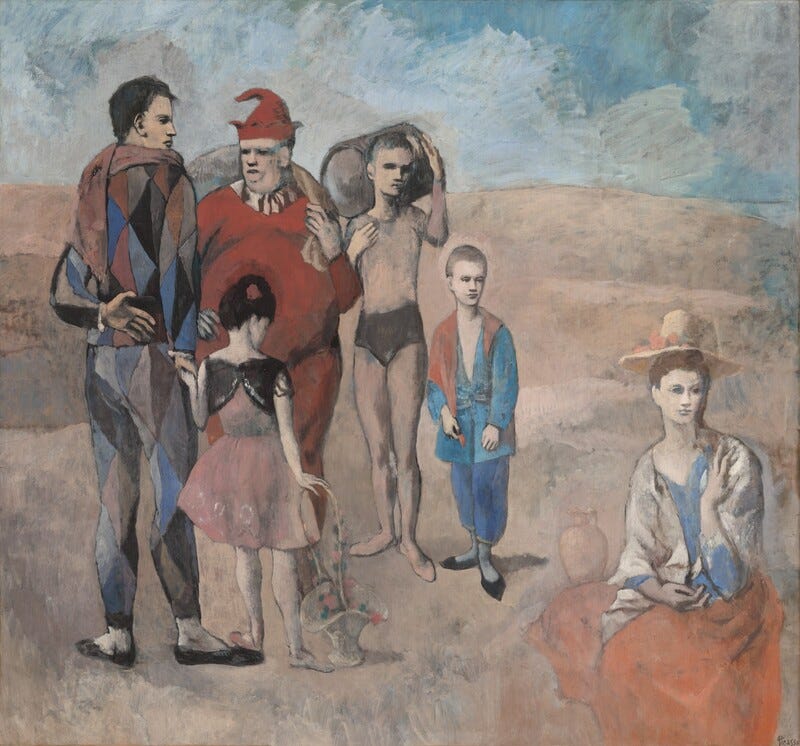
The whole act is possible not only because of municipal grace, but on a deeper level, because of friendship. How else to contort ourselves from tragedy, from Blue Periods, to change the ending, to become the lost book of Aristotle instead of being stuck in Tomis? It is a symmetry, Harlequin’s diamond pattern, because a friendship betrayed caused my Blue Period, revealed to me something true I didn’t want to know. The Rose Period paintings often feature a group of circus performers and marginal characters called Saltimbanques. My Saltimbanques, my confidants, fellow writers and minor poets, sustained me then and do still now. These are the kind of people in whom one can see a strange family, how the Neoclasssical gives way at the edges to something stranger, gestures toward the breakage of ordinary perspective, which is to say a possible happiness that underlies melancholy intrinsically. R says he’s Harlequin, and in Picasso’s Family of Saltimbanques (1905), Harlequin is a little bit R, his hand twisted behind his back, a dark clever face. J claims to be Zanni, in opposition to my theory that all writers are really, like E agrees, a weeping Pierrot, here in a little blue suit and black pointed shoes. But if J wants to be bodily, and looming, he’s the man in red, all girth and muscle so unlike him, holding perhaps, a bag of wonders, autobiography, some key to the American Sublime in the swans and the skyscrapers. Then there’s A—typical for A, she resists my Commedia dell’Arte typology, insists she is the Prince in the Love for Three Oranges, all false brides, all citrus made uncaptive, all Prokofiev run through Brubeck and back again.
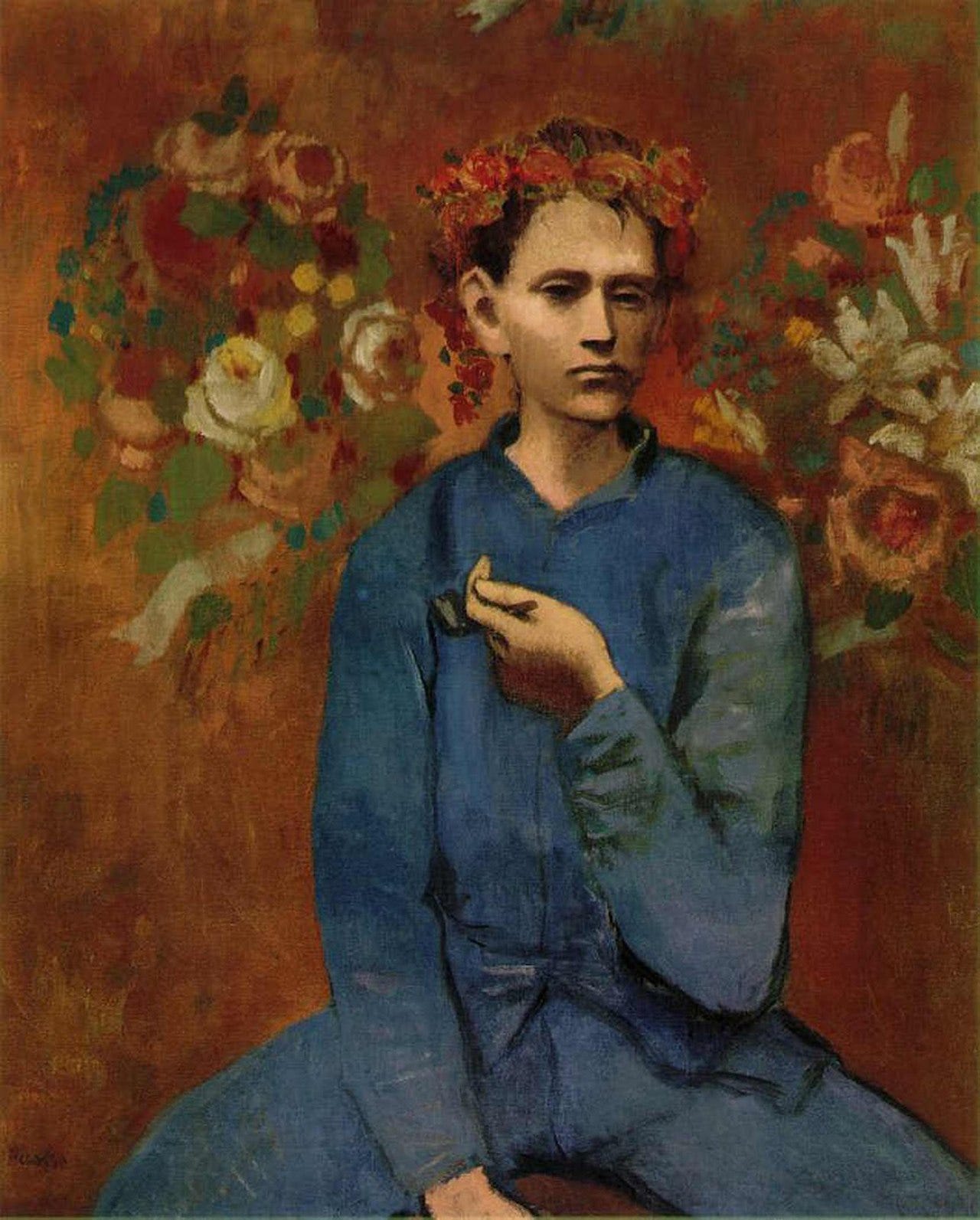
The coffeeshop near the park runs out of lemonade and gives me yuzu in my tea, which is delicious. During the Rose Period, Picasso becomes close to Apollinaire and other figures on the margins of French artistic society, venturing into the avant-garde. He settles himself more in Paris. There is a certain peace of mind with streets becoming your streets, a language becoming your language, especially if you—as I, as Picasso, as many of my friends and his—have lived a peripatetic life. Now it’s “My Mayor Muslim/My bagel Jewish/My Christian Dior,” which is to say the possessive kicks in for me in New York City all at once like a flourishing. My Saltimbanques are everywhere, mostly not here, but to feel at home one must have a whole constellation, a new sign to be born under. When you figure out who really values what you value, who wants what you want, who holds dear what you hold dear and would never betray it, you can relax again, smoke your pipe in your crown of roses in your working blues, ring your hair in claw clips and get lipstick on all the iced tea straws on the Q and the B trains. You can be diffident to observers better when you have the confidence of a troupe behind you, networked stars, subway lines, split into hemispheres across the world though they are, like the two halves of a basketball court, the round parts under the baskets, the New World and the Old, both of which have been homes to me, and both of which now finally converge at the buzzer.
There’s a poem by Apollinaire about the Saltimbanques, a simple one, that I render in my own English here1:
Along the plain, the players
Move along past the gardens
Before the doors of grey inns,
Through villages without churches.
And the children walk in front,
The others follow, lost in dreaming.
Each fruit tree resigns itself,
When from afar they wave to it.
They carry weights, round or square,
Tambourines, and gilded hoops;
The monkey and the bear, wise animals,
Beg for coins as they make their passage.
This is not to say I’ll never be melancholy again. I definitely will be. This is to say that right now, I get to lose myself in dreaming a little, a respite in early summer. When you are a Saltimbanque or a painter in early 20th century Paris, you live on the edge of society, but you can still pass through it and be of it sometimes, and this not a little grey inn in a village without a church. This is the epicenter of the gilded hoops and tambourines; does it really hurt to wave to the fruit trees and the bodegas and the subways, and watch them nod back a little? Is it crime to let it wash over you, the city? Yes, the monkey and the bear still collect their coins, little sous, and we all, and my Saltimbanques, write grants and publish, sing for our suppers. Here too we are acrobats, the circus of our strangeness in letters, and a ragged checkered tent in the meadow is where we perform it, not some safe and glittering stage of known quantities. We are unknown and we know ourselves to be so.
This is the Rose Period: to be still unknown but confident in pinks, light oranges, white ruffs, a hint of ochre. This is the Rose Period: to come into where you are in the world and make art like you finally know it. This the Rose Period. Can you see me, past the celebrating in the streets, sitting with my fellow Saltimbanques, inscribing my new oscillating acrobatic happiness like a bourrée, like dribbling, like the regularizing of unfamiliar possessives.
The original French:
Les Saltimbanques

Dans la plaine les baladins
S'éloignent au long des jardins
Devant l'huis des auberges grises
Par les villages sans églises.
Et les enfants s'en vont devant
Les autres suivent en rêvant
Chaque arbre fruitier se résigne
Quand de très loin ils lui font signe.
Ils ont des poids ronds ou carrés
Des tambours, des cerceaux dorés
L'ours et le singe, animaux sages
Quêtent des sous sur leur passage.
❤️
Congrats on the manuscript news!