Conjectures on Goldbach’s Conjecture Denoted As Every Prime Number Under One Hundred
loose thoughts on pure mathematics, elegance, literature, love and other problems

“Goldbach’s Conjecture is one of the oldest and best-known unsolved problems in number theory and all of mathematics. It states that every even natural number greater than 2 is the sum of two prime numbers. The conjecture has been shown to hold for all natural numbers less than 4×10¹⁸, but remains unproven despite considerable effort.” – start of the Wikipedia Entry for Goldbach’s Conjecture
7 = 5 +2
34 = 3 + 31 = 5 + 29
1202=1153+49 = 1129+73 = 1069+133
And so on, though as the thing says, since it has been shown to hold for natural numbers less than 4×10¹⁸ there is a lot of so on to get through.
2. If you prove this you can maybe then prove the Riemann Hypothesis, which will get you a million dollars, and probably the deep structure of the universe, so everyone get on that.
3. Goldbach wrote a letter to Euler in 1742 proposing the Conjecture. The fact that I can you more about the historical context of the letter than the number theoretical implications of the Conjecture is evidence alone that I was never built for pure mathematics, a thing I really loved the idea of loving for a very long time, but could never be good enough at to truly know, much less love.
5. Goldbach has a lovely cursive script in the letter. Technically a cursive is just a type of currens, which is to say running script, from the Latin. Euler is pronounced “oiler” like the rig, which is a sort of weird emblem of contemporary stereotypes of masculinity, that do not often include number theory, which is strange, because pure mathematics for most of its history did not admit very many women.
7. I love deep architectures, secret knowledges. This is why I always wanted to love pure mathematics. If a woman proved the Riemann Hypothesis, or Goldbach’s Conjecture, I would fall in love with her immediately, because she would have deep set feeling about why things are ordered the way they are, which is all I have ever wanted from life.
11. Hardy and Littlewood did some work on Goldbach’s Conjecture before Second World War at Cambridge. They were lovers in some capacity. Hardy also played a near-professional game of tennis.
13. The Goldbach Conjecture is loosely related to mathematical cryptography and Turing, for whom the Second World and its consequences in the Enigma machine were subsequently an intellectual triumph (the decryption) and disaster (his shunning and chemical castration by the British state for homosexuality, which ended in his suicide).
17. I loved Bletchley as a child. I wanted to get good at cryptic crosswords so if there ever was another Bletchley they’d pick me to break codes there. There were some Americans. In any event, when I moved to Britain during my graduate school years, I was always bad at cryptics in the TLS because my own internal sense of sound and rhyme scheme was still American, despite my taste in literature. Ironically, I would have been more useful for knowing German. In the end it was helpful the German Enigma operators often set the rotors to their girlfriends’ initials or felt obliged to start every messaged with “Heil Hitler”. Consistent repetition of plaintext is always a mistake for cipher security.
19. Ciphers are almost as old as human writing. They often depend on probabilities and heuristics to work. Prime numbers are good for this. Hench, the relevance of Goldbach and his Conjecture. Goldbach was an efficient Prussian administrator who also did some work on ballistics.
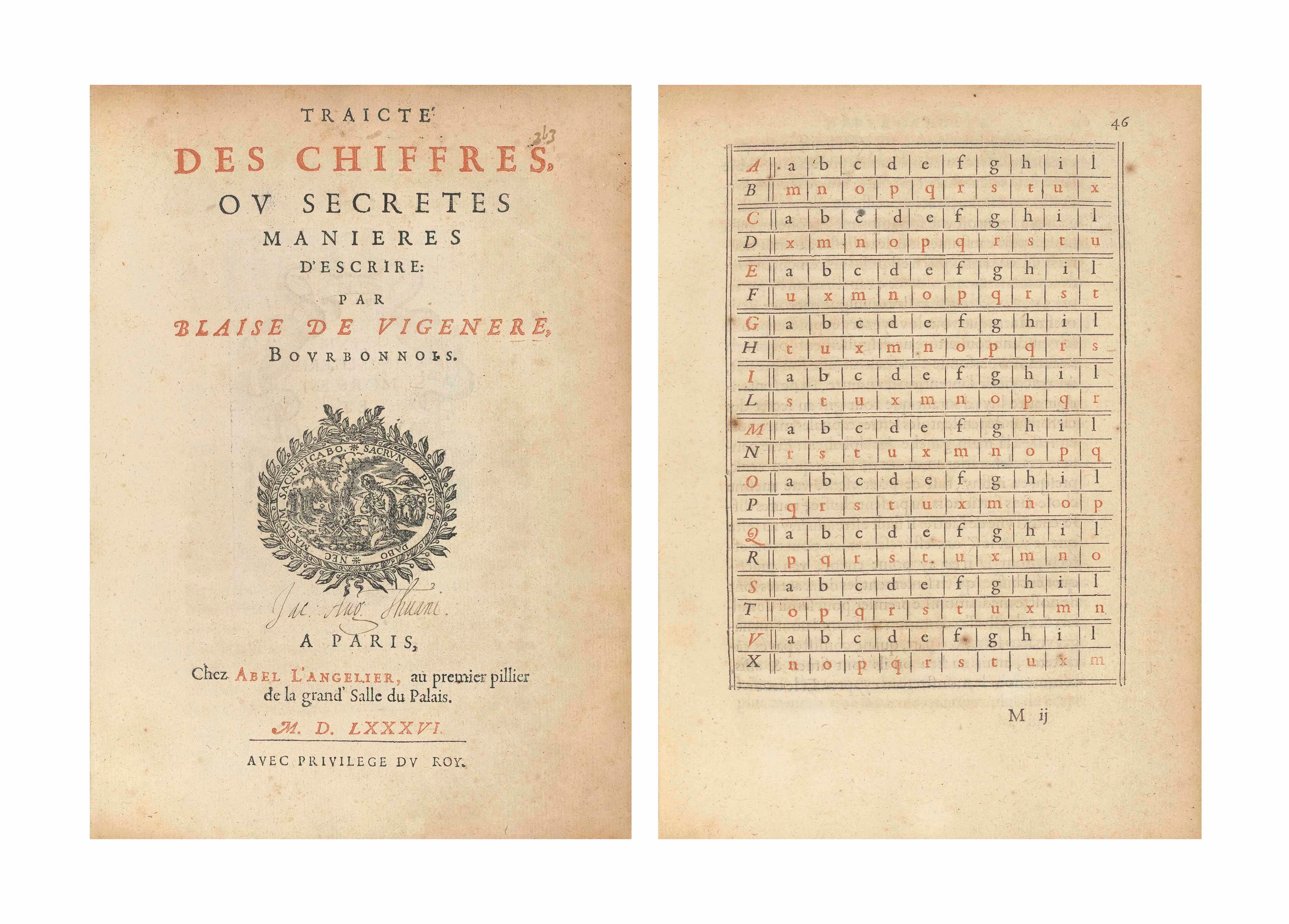
23. When I write in cipher text I feel free, even if the plaintext is stupid, even if it can be cracked very quickly by brut force and a computer, because the reader has to know it’s cipher text in the first place. I did this with Vigenère cipher recently because someone was reading my Twitter feed with a paranoid closeness, and it made me feel watched, overseen.
29. People like to assume cipher text is about them in the same vein that you’re so vain this song is always about you. When they can’t read something they get extra paranoid and narcissistic. Before auto-translate, foreign languages in difficult scripts had this effect too.
31. It is about you and about me though. If an AI proof works for the Riemann Hypothesis and particularly for the Goldbach’s Conjecture, I will lose a piece of my humanity forever. It would break my heart and shatter all my veins. It feels like a thing that should belong to a human mind, given that number systems as they stand are probably human constructs that approximate some underlying fundamental truth. But that claim itself is speculative conjecture.
37. The Four Color Theorem was proved with computer assistance in 1976, partly just by trying out a lot of combinations in ways people can’t. Mathematicians and people who cared thought it was inelegant to do this. The proof wasn’t verified until many years later, and the verification also required computational help.
41. The concept of elegance in mathematics is not merely or even at all a proof of a theorem in the fewest possible steps. It is using methods from related disciplines in unexpected ways, surprising the reader with turns of rational thought, steps that seem to lead one way but go another, and then whip back around. Alan Turing’s own proofs were like this. So were many of Hardy and Littlewood’s to the extent that I understand them.
43. I often wonder what the equivalent of mathematical elegance looks like in literature. Or in criticism.
47. I often wonder if mathematical elegance is one of the ways of feeling intrinsically human while still perceiving something beyond human structures.
53. Codes and ciphers also make me feel free because their use and history is profoundly human, but their structure is not. They rely on fundamental things about the distribution of numbers. The human part relies on the structure of language. Cryptography yokes these two disparate architectures of thought into one.
59. A tell for Vigenère cipher is that there are too many consonants. The distribution of consonants in English plaintext never has so many. A few people noticed this when I put my ciphertext out in the wild. Many ciphers have tells that help you break them. This is in part how Turing and the Bletchley Cryptographers cracked Enigma.
61. I like to think writing criticism is a little bit like cracking ciphers, because it’s about noticing patterns. The same thing is useful in the exercise of forming a mathematical proof.
67. Admittedly, seeing literature or criticism through the lens of mathematics is like living on an oil rig, in that you regularly know about four other people total who do the same thing and you can only talk to each other about it. You are out there alone in the beating sea.
73. We should have conjectures, too, in literature. We should sometimes solve them elegantly. Maybe criticism is more like meta-mathematics, like Gödel’s Incompleteness Theorem, whose proof also relies on the properties of prime numbers.
79. I would love to love someone who understood this particular elegance. But here I am repeating my plaintext, and repeating your plaintext is a dangerous thing for the integrity of a code or cipher.
83. … plus 1 is 80. plus 7 is 86. See you can just keep summing prime numbers to get every natural one. It’s a song that’s never and always about you, and someone is never and always watching, because the system is always there underpinning itself, reflexively.
89. Gödel’s Incompleteness Theorem roughly established that the mathematical system was not complete insofar as every proposed conjecture in its logic does not necessarily have a proof in that same logic out there. It is possible that there is no proof for Goldbach’s Conjecture or the Riemann Hypothesis.
97. At the end of a proof, one traditionally writes “Quod erat demonstrandum”—that which was to be demonstrated. Q.E.D.
No Q.E.D.. I haven’t proven anything here. It’s all mere conjecture. There is a certain delicious promise to conjecture.
love this piece. have often pondered these questions as well (it’s human).
these might interest.
a fun book.
https://www.nytimes.com/2023/04/11/books/review/once-upon-a-prime-sarah-hart.html?action=click&module=Well&pgtype=Homepage§ion=Books
and two more.
https://www.nytimes.com/2017/04/15/opinion/sunday/the-worlds-most-beautiful-mathematical-equation.html?action=click&pgtype=Homepage&clickSource=story-heading&module=opinion-c-col-left-region®ion=opinion-c-col-left-region&WT.nav=opinion-c-col-left-region&_r=0
https://aeon.co/essays/how-should-we-define-mathematical-beauty-in-the-ai-age
enjoy.