Blue Period
on being the target of cruelty between women, and on making a life in art as a woman outside of the clinic and the asylum as aspirational gazes

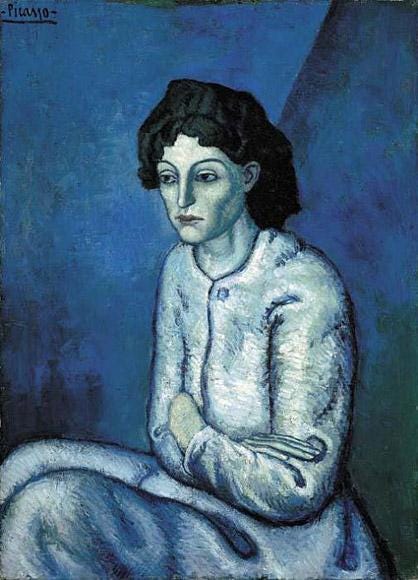
You’d expect me to say I prefer Braque. It would be in keeping with my love of things with a particular obliqueness to the order of the world (baroque opera, Japanese postwar architecture, ice cream that’s just sweet cream flavored). I really do like Picasso’s Blue Period though, even knowing all the things a cursory historical and biographical background of the artist gives you, even knowing that do so is in itself a cliché that doubles back on itself, like Mozart, to become a thing you can unironically like because it’s good even if you’re contrary. The women from the Blue Period often cross their arms, stare out into space with a piercing density that makes the gaze tangible. There’s a heavy hint of theological mapping, but also some commedia dell’arte, because we live wrong life wrongly in all the modes at once, sacred and profane. We should probably learn to live otherwise, but can’t, so we do the second-best thing and know through depicting our wrong lives somehow rightly.
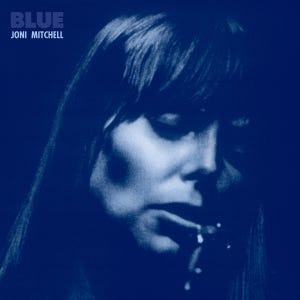
I’m sitting on the sofa crossing my arms like that, Femme aux Bras Croisés (1901-2), but don’t worry it’s not a Saint-Lazare situation. Actually if you think about it, the way I’m writing this, I’m not any of the women in the prison-hospital Picasso often painted, I’m the painter; I have agency here. This is one of my blue periods. I’ve been staring from the sofa to Joni Mitchell today, to Blue, her 1971 melancholic master album, sung in her high clear voice.
Blue
Songs are like tattoos
You know I’ve been to sea before
Crown and anchor me
Or let me sail away

I’ve been to sea before. At this point in my life when I turn in the mirror I look more like Joni. I’ve noticed that like that famous tinted, underlit picture on the album’s cover, the hollows of my cheeks are starting to show more in my face. It’s ironic that the real-life instigator of this particular Blue Period for me evokes the Blue Period Portrait of Suzanne Bloch in a lot of uncanny ways as a person. Picasso doesn’t do this situation I’m in at all, he doesn’t know it or how to do it, but this portrait, or all the women in the Blue Period paintings, could be short stories, chapters of a linked novella about women’s capacity for cruelty to each other, the kind of thing Margaret Drabble could write. Or maybe early Margaret Atwood, like Cat’s Eye, like Joni Mitchell, somehow Canadian in the way she is able to frame social pain with detachment and close exactitude at once.
In our wrong lives now, little cruelties of the Cat’s Eye variety are even more possible, allusions known only to participants online in front of thousands of people, barbed specifically both to make them hurt more and to make the mechanism of full disclosure impossible. Both the antagonist and the victim know telling the truth online, the complexity of reality, always makes you lose. So making little digs in anonymity on social media is the best way to hurt someone without consequences, and that’s what the Portrait of Suzanne Bloch has been doing to and at me. But also: I’m no innocent. What do you think I’m resorting to now? Crossed-Arms, Blue-Mode, Vagueness-As-Cover-Generalism. It’s a kind of cruelty that renders you complicit if you say anything at all. It’s all a trap, and it’s undignified by nature.
Still, I’m working the trap, the trap with my leg in it, with my tongue. Portrait of Suzanne Bloch is cruel to me right now mostly because she is jealous. I live in my own (rent stabilized) apartment in New York City, I have just finished my second book, and I am free to be anything I want, queerly or otherwise, without obligation to anyone else. There are many failings in my life, but these things are still true, and considering them I think, is what prompted the Portrait of Suzanne Bloch to try to hurt me in the public-private of the online. This is a woman’s cruelty; there’s a thing we do to each other when you can tell another woman wants to crawl inside your skin and take your life, or part of it. And because she can’t, she hurts you. Deep down she knows and you know she knows, but it doesn’t matter; the public hurt is the aim. Women take selfies in front of the Blue Period portraits now—maybe they don’t know about who was in the Saint-Lazare when Picasso visited? Prostitutes, criminals, desolate women who had tried to kill themselves in prison. Or worse maybe we all do, we do know, and we want to steal their madness as a chic front, an identity of damage without living with the real bodily or social consequences.
It’s the details that get you. Joni Mitchell’s love in Blue is a case of beer, a greasy pan, papers from the city. Portrait of Suzanne Bloch left receipts for hundreds of dollars of clothes and shoes, brands and types I would like but can’t afford to buy, littering my floor in her wake, dirty sheets on the bed, and perplexingly, a shower towel that hadn’t been used in four days. I flipped the folded towel over and over in my hands, and later in my mind, wondering in what moment my friendship became less interesting or valuable than punishing me in public, why she couldn’t just wash herself clean of me quietly. Or what about me suddenly made it worth making me a target of anonymous co-entrapment, what she needed from me in wanting to make me feel insufficient or hurt in public as opposed to just an email or text.
The Portrait of Suzanne Bloch claimed to pity me; this is a thing women often say as a tactic to render their target insecure. Incidentally, the actual painting Portrait of Suzanne Bloch, is a late Blue Period painting. Suzanne Bloch is herself an opera singer, not like the lower-class women of Saint-Lazare, bent over and pale, distantly staring in the earlier portraits. She could pity them. But she is melancholy too; even the bourgeois suffer, or imitate chicly the aestheticized suffering of the madhouse, the jail, and the hospital. I think of Angelina Jolie in Girl, Interrupted, the way everyone, particularly amongst women writers, wanted to be her in the 1990’s, the way it loops around again women competing with other women for the public recognition of their diffidence to the world, their orthogonality to its rules, not for real madness, but for its privilege of its exception. I would like to think you can get that by fighting for it as a politics or a style, not by claiming a retreat to the asylum, which after all, has yellow wallpaper and Foucauldian ways of keeping you in line.
I think I used to compete for this exception in the exact same bad way too, this public sense of being touched by a Sontagian tubercular pathos of the mind that made you special or different and not like an ordinary woman, not like the other girls and their normal lives for normal minds. The irony of this is that chronic illness— long, enduring, physical chronic illness— cured me of it, this temptation to asylum or hospital as recourse. I just want to be well enough to do all the things I love, to be fiercely in and of the world as it is. Now, I don’t want to compete with other women for perceived frailty or hard damage. I do have Blue Periods but they’re mostly transmutable; they’re things I can try to wriggle in the trap of to make art. Illness as metaphor as identity doesn’t appeal to me at all now; it’s too close, too real, too uninteresting in its badness.
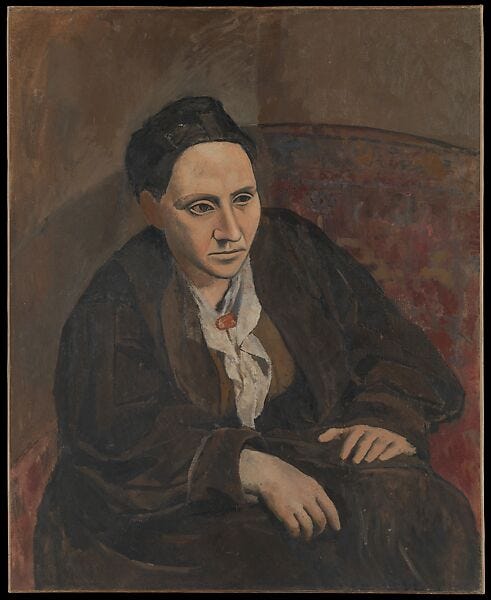
After the Blue Period, Picasso had a Rose Period. That’s when he paints the portrait of Gertrude Stein that hangs in the Met now. Gertrude Stein has her melancholies, her excesses of punctuation and black bile, but first and always she’s her modernist daring, her linguistic risk. She isn’t beautiful, nor is she perfect, nor even always admirable as a person. Gertrude Stein’s uneven eyes, gesturally but not literally Cubist, don’t meet any gaze, don’t seem forlornly to stare out some barred window. She’s a Joni too, a Margaret Atwood, her own Picasso, and maybe to even Picasso himself, an agentic equal. She makes things, and is judged by the world for them as art. She is this portrait’s subject but not in general a subject body.
This is what I want, I think this is what we all want, not to snipe or be sniped at in some sub-public competition for selfhood as women, but to stare back in multi-perspectival security, the uneven planes of our faces vehicles most of all for who we really are, our refusal to sit as merely subjects. My life isn’t worth the trap anyone could set; it’s worth more than nasty, cut-for-cut entanglement where we all lose and lose. I hope the Portrait of Suzanne Bloch stops trying to render herself new or better, or to feel better about her own life, by setting the teeth of public-private gaze on me, by claiming herself with respect to my work and selfhood instead of making her own renewed. Cruelty that leverages false perception of the unknown is ultimately sort of boring in a way, in that it doesn’t make any of our lives really change their quality, or the way they face the world. So it’s this just this, these lines Joni sings to me on the sofa plaintively, all Blue Period in the night: Crown and anchor me, or let me sail away.
Beautiful. Was in Rosalind Krauss’s “The Real Picasso” class this semester and she absolutely outlawed any talk about his women from day one- we were only to consider Picasso as a craftsmen / in his intentionality re form. Hard to relate to the gesture aside from to call it a survival strategy from a Great Woman who inevitably saw too much. Healing to read this now… thank you.
Very nice piece! And I hope you are healing now.