A Birthday Letter
from the tiled-hybrid heart of Roppongi, Tokyo, just a little worn and seedy around the edges

Dear Friends, Readers, and the infamous electric-wire-harassing crows of this city that I would be unsurprised to find are literate,
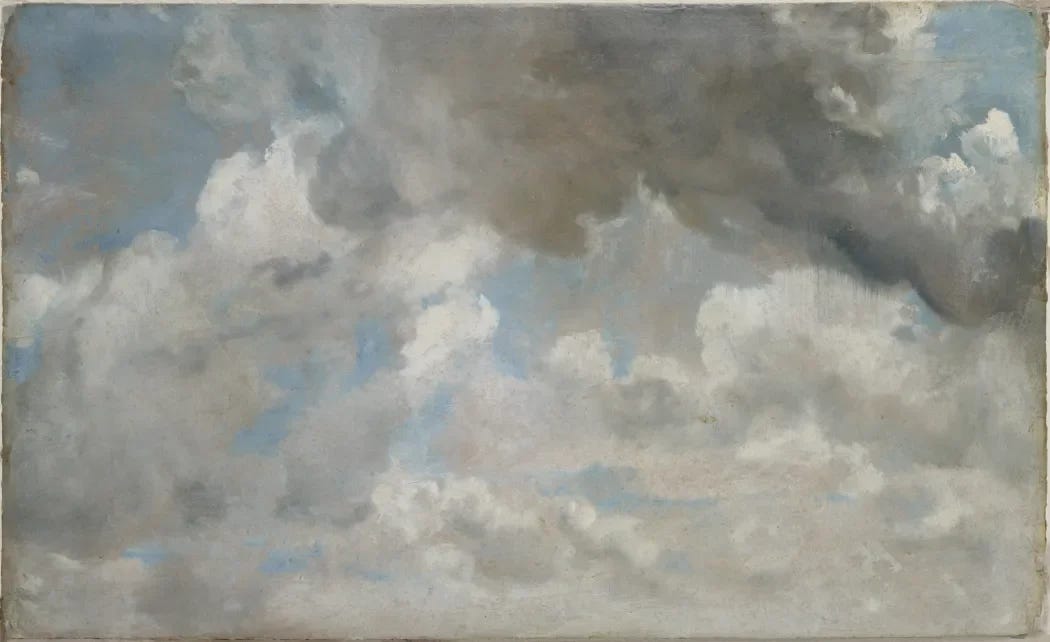
I never intended to start a Substack, mostly because I love editorial intervention almost as much as I love difficulty, but here we are. The fissure of social media platforms has made this perhaps the best place to reach everyone whose thinking and writing I care about. This will be an array of clouds, not final forms, but studies-in-progress, provisional ideas about things that could pieces, essays, parts of books. Sometimes, like this post, I just want to tell everyone what’s going on in my life and a little more. I know many of you know how much I love cloud studies in particular as a painterly genre, hence the name. Who amongst us has not gotten in trouble for trying to take a snap of that one frustratingly tempting Constable at the camera-forbidden Frick? Or even the real thing, lit up and puffed all the soufflé pancake I ate in Harajuku for lunch today, but up in the air, suspicious of the lens, a tangible-intangible form with a sky for a griddle, turned over by Zeus some lazy thunderclap Sunday.
Today, I turned 39 years old, give or take the international date line. I have run my hands over the granite of Kenzo Tange’s Tocho, and illicitly hugged a column, even as I read carefully Arata Isozaki’s claims that it is fundamentally empty. From Isozaki, I came to Barthes’ Empire of Signs, and my own figuring of Tokyo as always signifying. Given my positionality though, it never quite settles on a signified with respect to being for or about me, or only about me insofar as it is construed as ‘other’. Then it’s suddenly, intimately not ‘other’, like when I’ve floated on my back on an onsen on top of a skyscraper, my body an open door, running through the lines of Auden’s In Time of War, because this is our Age of Anxiety, or so I’m working out for the section late in These New Fragilities, my book in progress. It’s an other that is no easy occident-orient dichotomy, a postwar fusion that is both imperialist and subject state, both global modernist and as Isozaki would have it, a thing that struggles to become itself opposed to and with it simultaneously.
I have basked in the gentle sun inside Kisho Kurokawa’s final project— the National Art Center— as I thought about lateness and late style again. Late style is another key subject of These New Fragilities, and as I close out the manuscript I think of Said on Glenn Gould. Gould and Kurokawa’s geometric precision are not so different, but where Gould has a strident, almost sharp virtuosic turn in his late recordings, Kurokawa softens, turns the rectangle panes of the National Art Center’s glass into curvature, long soft rises into a sky that is no Constable sky, but knows its own quality of light intrinsically. Some things— claviers, buildings, a particularly short chair— are simply well-tempered in virtue of a mastery so heedful of technical skill it can become in the end, heedless.
For those of us born late early, there is no such ease of mastery, I think, only somehow, the desire be fundamentally otherwise, to make otherwise, to be heedless in a time of heed. Said gives Genet and Cavafy as examples of early writers born late from the start in terms of style. This year felt late for me; it was a struggle to live in lateness, to come to a terms of and with it. My beloved cat Lewis, known to many of you as Tuft, had a sudden heart attack and died. I was beset by severe chronic pain and migraine, then cured and wept with joy in front of a Fragonard. But somehow, this is also the year when I went back to serious ballet, performed, started pointework again. This is the year when the bulk of my book was written, the one I hope you’ll get to read in a little over a year or a year and a half. I don’t feel anything in particular about this age, 39, only that the world feels later than I do, that it’s always some new apocalypse. “What is a world without a calendar?” is one of the questions my book begins to ask. It begins with atrocity, with Gaza and Sarah Kane plays and the severity of waka, but ends here, somehow, with attending, futurity, what it means to do the best we can do with our lateness.
In three days I leave Tokyo and return to Brooklyn, to the collective heron I have come to love in Prospect Park, and the ever-complaining tracks of the Q. I cannot wait to see some of you. But most of all I hope my next year dances the orange of lateness a little more, except now it’s a yuzu, and gets into the pulp. I have three sets of linked epigrams coming out in the next few months in various magazines that I think do some of this. I will close out the manuscript draft of These New Fragilities, walk down to the Seven Stories office from Canal Street down to Watts past the neon and the cookware and the aquarium store with an array of tempting fishes, and I will hand it over to my editor, Rasheeda, who is excellent, and whom I trust. And then, truly, I’ll have time to study clouds again, to map their fractal edges in pastel, oil, graphite, etched lines in copper plate.
Today I bought new glasses that are really old glasses, Japanese deadstock, at a store down a quiet flight of stairs in Omoetesando. It was more elegant than me, the store, but the glasses feel right, clear slightly gold-tinged acetate with large round lenses cupping each eye as if it’s in some White Cube circular vitrine. When you see them, you are constitutionally obliged to either make a “Portrait in a Convex Mirror” joke, or better, one about grinding lenses, the consolations of telescope and microscope for the macro-and microcosm alike, and then mutter something about fixed and unfixed stars.
Tonight, to all the unfixed stars of my literary world, all the orbital lights dipping and swaying in some future pictorial calendar of minor miracles not limited to Augsburg, all of you, on the end of my new year, I send this meteoric little epistle, an ephemeral thing as all such things are—
AV M
Gorgeous meditation on lateness as both temporal position and aesthetic mode. The pairing of Kurokawa's softening curves with Gould's late recordings captures something crucial about how technical mastery can paradoxally enable a kind of surrender. I spent time in similar liminal spaces during my own 39th year and found that living inside that specific presure actually clarified what mattered versus what just felt urgent. The "meteoric little epistle" framing at the end undercuts itself perfectly, a permanant impermanence that's basically what good essays do anyway.
praying i look as good as you at 39